
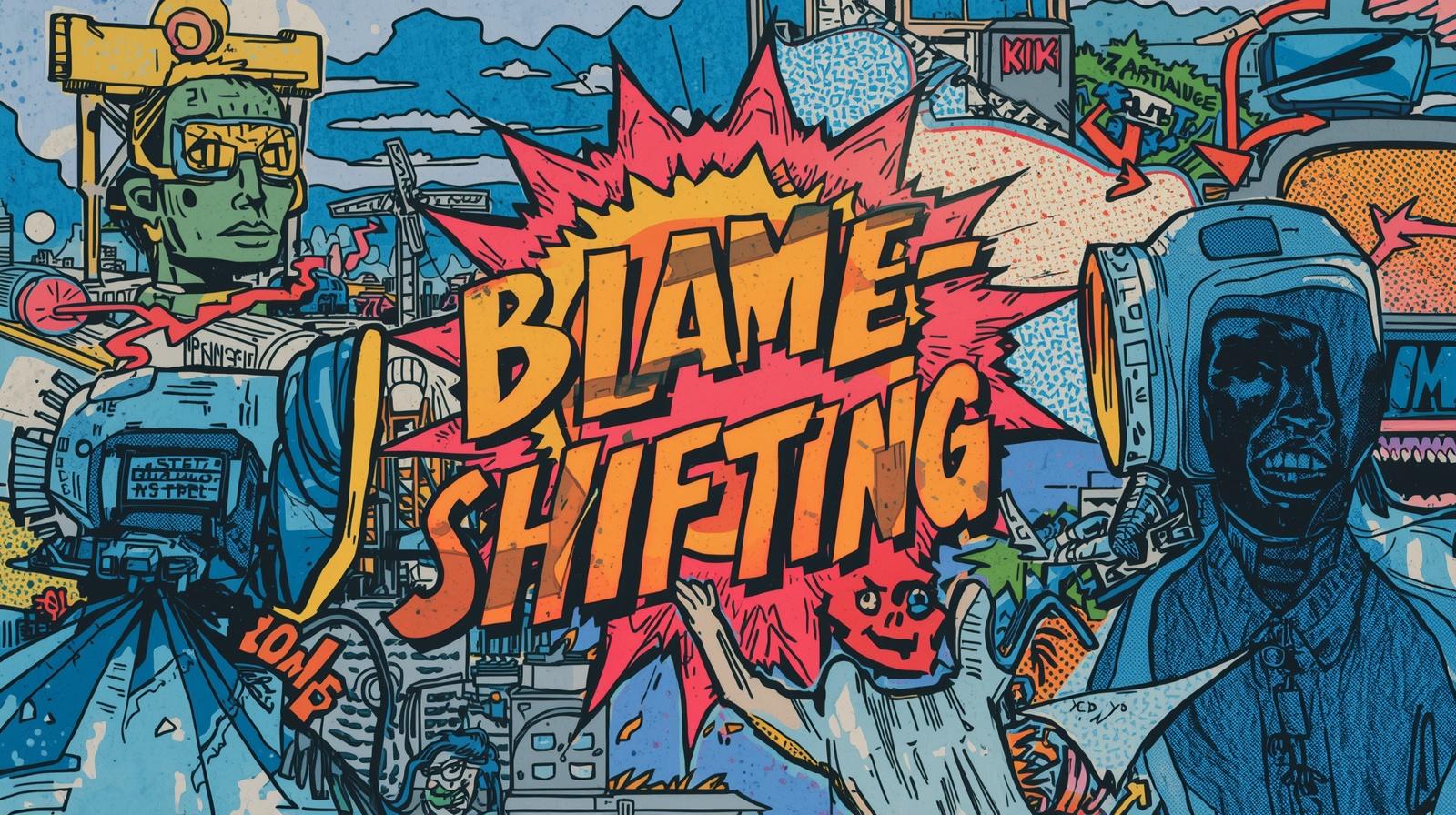
Blame-shifting rarely starts in the moment you notice it.
It might show up during a disagreement with a partner, a tense exchange at work, or that slightly awkward “who forgot to send the email?” conversation – but the roots usually go much further back.
Because blame-shifting isn’t just a bad habit or a convenient excuse; it’s a learned response.
One shaped over time by experience, environment, and a nervous system that’s trying – quite sincerely – to keep you safe.
You’re Not Born Good at Taking Responsibility
Despite what certain workplace cultures might suggest, the ability to take responsibility calmly and proportionately is not something we’re born with.
It’s something we learn – and crucially, we learn it in relationship.
When a child makes a mistake (which, for efficiency, they do regularly), the response they receive matters a great deal. In a supportive environment, the message tends to look something like:
“Yes, that didn’t go well. Let’s figure it out.”
There’s room for:
- Being wrong
- Repairing what happened
- Staying connected while doing so
Over time, that builds a fairly important internal belief:
“I can mess up and still be okay.”
And from that, accountability becomes tolerable.
When Responsibility Feels Like a Threat
But not everyone gets that version.
In some environments, mistakes are met with:
- Anger
- Criticism
- Humiliation
- Disproportionate consequences
In those cases, “I did something wrong” quickly becomes associated with:
- I’m in trouble
- I might be rejected
- This is not safe
For a child, that’s not a small thing. Connection to caregivers is essential, so the system adapts.
And one very effective adaptation is:
“Don’t be the one at fault.”
So instead of:
“Yes, I did that,”
the response becomes:
“It wasn’t me,” or “It wasn’t really my fault.”
The child isn’t trying to be difficult – they’re simply trying to avoid something that genuinely feels threatening, and over time, that response gets wired in.
The Other Side: When No One Models Accountability
Interestingly, blame-shifting can also develop in the opposite kind of environment – where accountability isn’t harshly punished, but barely exists at all.
For example:
- Caregivers avoid taking responsibility themselves
- Problems are ignored or brushed aside
- Emotional experiences are dismissed (“It’s not a big deal”)
In these situations, the issue isn’t fear of punishment: it’s a lack of structure.
The child doesn’t get a clear model for:
- How responsibility works
- How to navigate mistakes
- How to repair things when they go wrong
So when something does go wrong later in life, it can feel confusing or chaotic.
Blame-shifting then becomes a way of creating order:
“Something happened. Someone must be responsible. It’s not me – so it must be them.”
It’s less about avoiding punishment and more about trying to make sense of things.
What About Emotions? (They Matter Quite a Bit)
Another key factor is how emotions were handled growing up.
If feelings like sadness, fear, or frustration were:
- Dismissed (“You’re overreacting”)
- Criticised (“Stop being so sensitive”)
- Ignored altogether
then vulnerability itself can start to feel unsafe – and it’s at this point that blame-shifting becomes particularly useful, because taking responsibility often involves some degree of vulnerability:
- “I got this wrong”
- “I hurt someone”
- “I didn’t handle that well”
If those states feel risky, the system looks for a way around them.
Blame-shifting provides that route.
It keeps you in a position that feels more stable:
- More certain
- More justified
- Less exposed
From Strategy to Autopilot
Over time, these responses stop being conscious decisions, and they become automatic.
The nervous system learns:
“Responsibility = discomfort (or danger)”
“Deflecting = relief”
– and because that relief is immediate, the pattern gets reinforced.
Each time blame is shifted and discomfort decreases, the brain quietly notes:
“That worked. Let’s do that again.”
Eventually, it happens so quickly you don’t even realise it’s happening.
When Identity Gets Involved
Blame-shifting becomes even more likely when self-worth is tied to being:
- Competent
- Fair
- “A good person”
In that context, responsibility isn’t neutral. It carries weight.
It can feel like:
“If I’m at fault, what does that say about me?”
So the stakes go up.
Admitting:
“I contributed to this”
can feel uncomfortably close to:
“There’s something wrong with me.”
Blame-shifting then helps us to maintain a more stable identity by keeping that conclusion at bay.
Why It Still Shows Up in Adulthood
By the time you reach adulthood, these patterns are well-practised and the nervous system isn’t particularly concerned with whether a situation is objectively dangerous – it responds to what feels familiar.
So when something happens that resembles earlier experiences:
- A partner expresses frustration
- A colleague gives feedback
- Someone questions your behaviour
the system can react as if the stakes are much higher than they actually are, which is why the response can feel a bit… disproportionate.
Because in effect you’re reacting to both:
- The current moment
- And the emotional memory attached to it
A Quick Note on the Brain (Nothing Too Heavy)
When the brain detects social threat such as criticism, judgment, or disapproval, it shifts into a more protective mode.
In that state:
- Thinking becomes more black-and-white
- Attention narrows
- The priority becomes self-protection, not nuance
Blame-shifting fits perfectly here because it provides:
- A quick explanation
- A clear “cause”
- Immediate relief
The downside is that it often oversimplifies what’s actually going on.
Thinking Patterns That Keep It Going
Over time, certain cognitive habits can reinforce blame-shifting.
For example:
- Attributing success to yourself (“I did well because I’m capable”)
- Attributing problems to others (“This went wrong because of them”)
Add in a bit of confirmation bias – noticing the evidence that supports your view and ignoring what doesn’t – and the narrative becomes quite convincing.
“See? This keeps happening. It’s not me.”
And because it feels consistent, it feels true.
Relationships Can Make It Worse (Or Better)
Blame-shifting doesn’t happen in isolation.
In some relationships, it becomes a kind of back-and-forth rhythm:
“This is your fault.”
“No, it’s yours.”
“Well, if you hadn’t…”
At that point, both people are trying to protect themselves, and accountability quietly disappears from the conversation.
Over time, this can become the default way of handling conflict and whilst neither party may intend for that to happen, the pattern of blame-shifting is reinforced by the dynamic.
The Control Illusion
There’s also a more subtle factor: control.
Blame-shifting creates a clear story:
“This happened because of that person.”
Here, clarity can feel stabilising – especially when things are messy or uncertain, but it’s a bit of a shortcut because while it provides a sense of order, it doesn’t necessarily reflect the full picture; without that, it’s harder to actually change anything.
At the Core
Underneath all of this, blame-shifting is doing something quite specific:
It’s helping you avoid the emotional experience of responsibility.
Not responsibility itself – just the feeling of it:
- Guilt
- Regret
- Self-doubt
- Vulnerability
If those feelings are hard to tolerate, the system finds another route, and blame-shifting is one of the fastest.
So What Does This Mean?
Understanding the causes of blame-shifting doesn’t excuse its impact – especially in relationships where it can be frustrating or hurtful – but it does make it more understandable.
Instead of:
“Why am I like this?”
it becomes:
“Ah — this is something I learned.”
And importantly:
“If it was learned, it can also be unlearned.”
We don’t have to make this shift instantly or perfectly, but we can learn how to interrupt it gradually by building the capacity to stay with a little more responsibility, without it tipping into shame or overwhelm.
A Slightly Better Question
When you notice the impulse to shift blame, you don’t need to eliminate it on the spot.
You can just pause and ask:
“What feels uncomfortable about this being partly on me?”
It’s not the easiest question.
But it tends to lead somewhere more useful than:
“Whose fault is this?”
And usually, that’s a good place to start.
Want to work with this pattern more closely? Take the ‘pay what you can’ YouTube workshop here.
Join my growing community on Instagram @DrMaddieSmith for more insights into pain patterns and how to use them to transform your life…and our world.
© 2026 Dr Madeleine Smith. All rights reserved.
Leave a Reply