
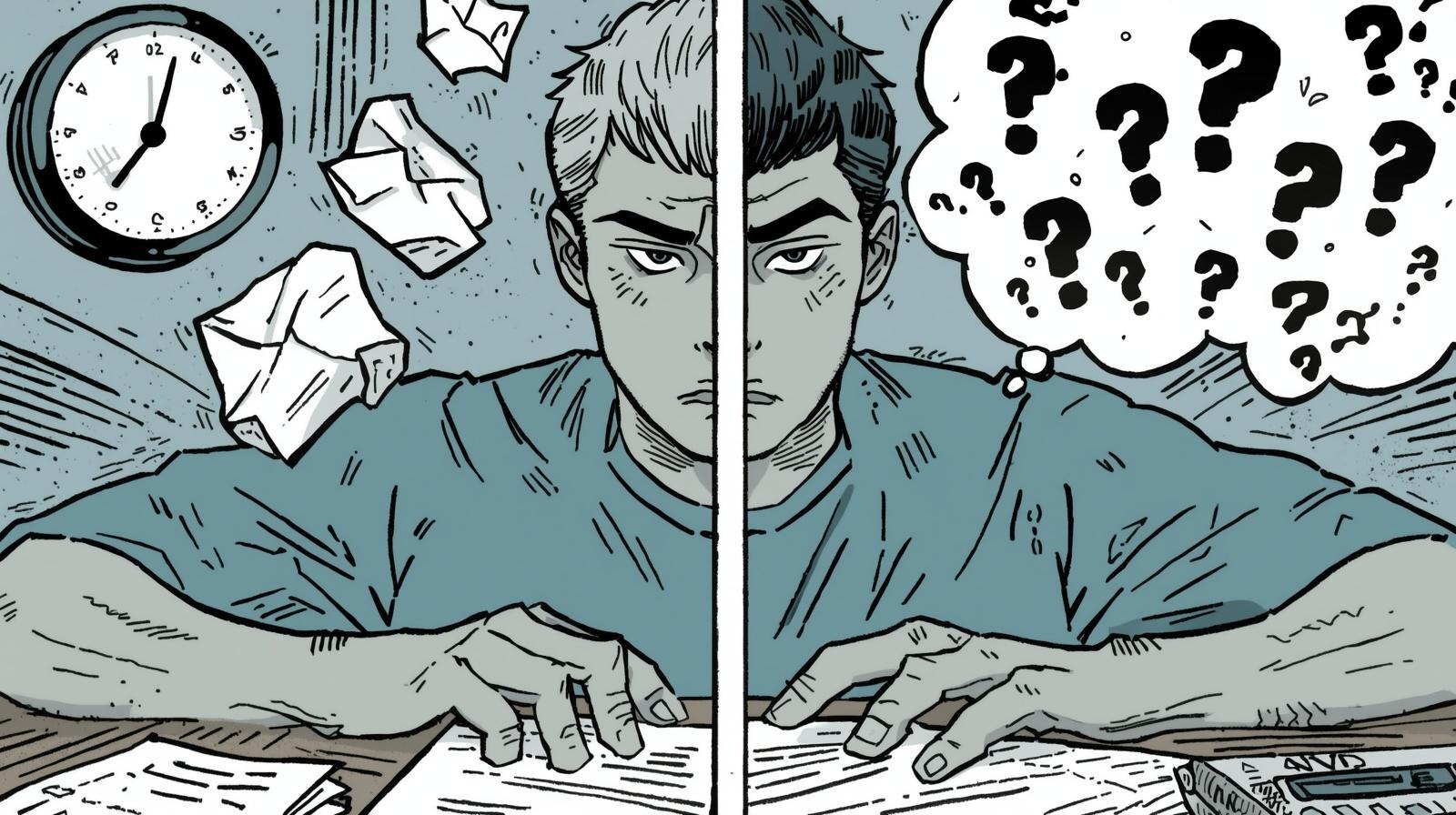
Self-doubt doesn’t politely stay in your head.
It leaks.
What starts as internal hesitation slowly turns into visible patterns – delay, avoidance, over-preparing, checking, re-checking, and occasionally staring at your phone like it personally betrayed you.
Because the goal underneath self-doubt is safety, the behaviours it creates are all about reducing risk. Prevent the mistake. Avoid the exposure. Minimise the chance of regret.
The problem? Over time, these behaviours reinforce uncertainty instead of resolving it.
Here’s what that can look like.
Repeatedly Asking for Reassurance
You might find yourself frequently checking in with others before making even small decisions:
- “Do you think this is okay?”
- “Does this sound right?”
- “Would you do it this way?”
Wanting perspective is normal. Healthy, even.
But when reassurance becomes a requirement rather than a preference, it often signals something deeper: difficulty trusting your own internal compass.
And even after someone reassures you?
Relief might last five minutes.
“They said it’s fine… but what if they’re just being nice?”
So you either ask someone else – or reopen the mental case file.
Over time, this builds reliance on external approval instead of strengthening internal confidence.
Delaying Decisions Until the Last Possible Moment
This kind of procrastination isn’t laziness.
It’s hesitation dressed as scheduling.
You might:
- Put off responding to invitations
- Avoid choosing between options
- Leave applications half-finished
- Delay difficult conversations
The longer you postpone, the safer you feel – temporarily. As long as you haven’t committed, you haven’t risked being wrong.
But then the deadline approaches. Anxiety spikes. You make a rushed decision under pressure.
Avoidance followed by panic is not exactly the calm, strategic process you were hoping for.
Delay feels protective. In reality, it just compresses the stress into a smaller window.
Over-Researching and Over-Preparing
Preparation is useful.
Excessive preparation is often fear in a productivity costume.
You might:
- Research a relatively small purchase for hours (or days)
- Plan conversations in meticulous detail
- Compare every possible option before choosing
- Create elaborate contingency plans for scenarios that may never happen
The belief underneath is simple:
“If I’m prepared enough, I won’t fail.”
But no amount of preparation eliminates uncertainty. At some point, research stops adding clarity and starts adding noise.
You close one browser tab and open three more.
Somewhere along the way, action quietly moved to the bottom of the to-do list.
Switching Between Options Without Committing
Self-doubt makes commitment feel risky.
So you oscillate.
- You feel excited about a plan… then immediately doubt it.
- You start a project… then abandon it.
- You change your mind repeatedly.
- You keep multiple options open “just in case.”
Keeping doors open feels safer than closing one – even temporarily.
But momentum requires staying with a direction long enough to gather real feedback. If you constantly pivot before results appear, you never collect evidence that you can handle the outcome.
It’s hard to build confidence in something you never fully commit to.
Avoiding New Experiences
Growth requires stepping into unfamiliar territory.
If mistakes feel dangerous, unfamiliar territory feels like a trap.
You might avoid:
- Applying for opportunities
- Trying new hobbies
- Sharing creative work
- Taking leadership roles
- Expressing strong opinions
The fear isn’t just failure.
It’s exposure.
Being seen trying (and possibly struggling) can feel deeply uncomfortable.
Avoidance reduces short-term anxiety. But it quietly reinforces the belief that you cannot handle uncertainty.
And that belief gets stronger every time you opt out.
Rewriting Messages Multiple Times Before Sending
A classic.
You draft the message.
You adjust the tone.
You delete a word.
You add a qualifier.
You remove the qualifier because it sounds insecure.
You reread the whole thing.
You wonder if it’s too direct.
You consider starting over.
Excessive editing often reflects a desire to control perception.
If the wording is perfect, no one can misinterpret you. No one can criticise you. No one can think the wrong thing.
Except perfection doesn’t exist – and most messages are not nearly as high-stakes as your nervous system suggests.
Sometimes it’s just an email. Not a diplomatic treaty.
Over-Explaining and Justifying Yourself
You might notice a tendency to over-justify decisions – even when no one asked for an explanation.
- Giving detailed reasons for simple preferences
- Anticipating objections before they arise
- Over-apologising for your choices
It can sound like:
“I’m so sorry, I just thought maybe it would be better because of X, Y, and Z…”
The underlying impulse is protection. If you explain thoroughly enough, maybe no one will criticise you.
But over-explaining can signal something deeper: uncertainty about your right to choose freely.
Difficulty Following Through
Even after you decide, doubt can resurface.
You might:
- Hesitate midway
- Reopen the decision for review
- Abandon projects when uncertainty appears
- Seek new information that destabilises your original choice
This interrupts momentum.
And every time momentum breaks, the narrative strengthens: “See? I struggle with commitment.”
When in reality, you struggle with tolerating uncertainty – which is a very human thing.
The Reinforcing Loop
Here’s the tricky part.
These behaviours feel protective.
But they often strengthen the cycle of self-doubt.
- The more you seek reassurance, the less you practise self-trust.
- The more you delay decisions, the scarier they feel.
- The more you over-research, the more complexity you uncover.
- The more you avoid risk, the less evidence you gather that you can handle it.
The loop looks like this:
Hesitation → Avoidance → Reduced confidence → More hesitation.
And around it goes.
The Underlying Pattern
At its core, these behaviours reflect one thing:
Uncertainty feels unsafe.
So instead of moving through discomfort, the system tries to manage it externally — by delaying, perfecting, checking, or avoiding.
But confidence doesn’t come from eliminating risk.
It comes from engaging with it and discovering (sometimes awkwardly) that you survive.
When self-doubt shapes behaviour, life can start to feel narrow. Carefully managed. Carefully filtered. Carefully rehearsed.
Recognising these patterns isn’t about judging yourself.
It’s about awareness.
Because once you see how hesitation operates in your actions, you can experiment with something small and radical:
Choosing.
Acting.
Sending the message.
Closing the extra tabs.
Not recklessly, or impulsively.
Just enough to remind your nervous system that you can move, and handle what follows.
Want to work with this pattern more closely? Take the ‘pay what you can’ YouTube workshop…
…or grab access to the mini-course here.
Join my growing community on Instagram @DrMaddieSmith
© 2026 Dr Madeleine Smith