
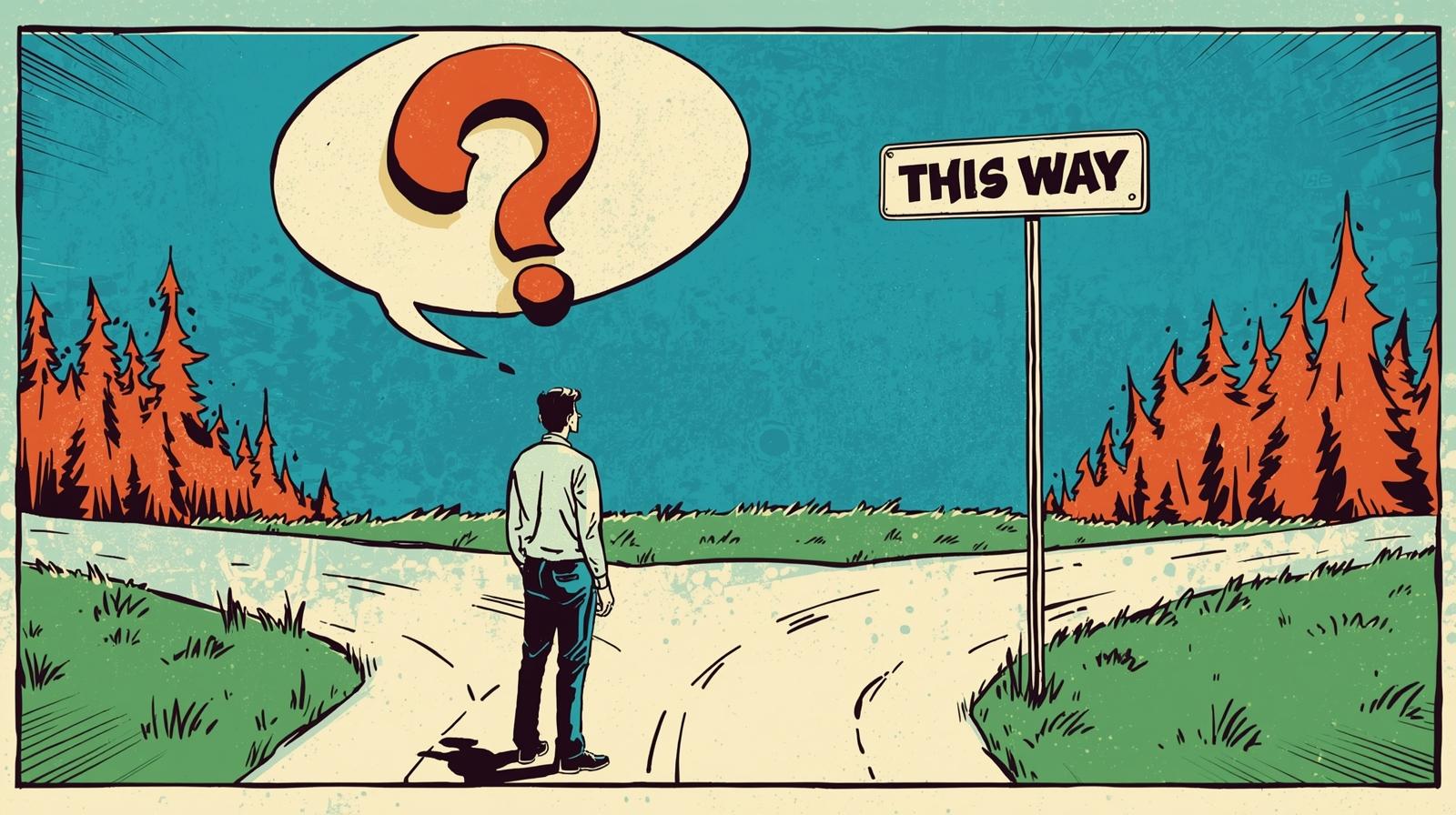
You know the moment.
You’ve written the email. It’s polite. It’s clear. It’s completely normal.
And yet… you reread it. Then tweak one sentence. Then reread it again. Then wonder if the tone is “too much.” Then consider adding an exclamation mark. Then delete the exclamation mark because, what if that’s too much??
Twenty minutes later, you’re still staring at it.
Welcome to the world of self-doubt and over-analysis – where even small decisions feel oddly high stakes, and your brain insists on conducting a full risk assessment before you choose a sandwich filling.
What Is It, Really?
Self-doubt and over-analysis form a pattern where trusting your own judgment feels… unsafe.
Decisions (big or small) carry disproportionate weight.
What to say in a message.
Whether to take an opportunity.
How someone interpreted your tone.
What career move to make.
Instead of deciding and moving forward, your mind enters a loop:
- Weigh the options
- Imagine five possible outcomes
- Mentally rehearse conversations
- Replay past decisions for errors
- Ask someone for reassurance
- Still feel unsure
It feels responsible. Thorough. Mature, even.
But it rarely brings relief.
Underneath it all is a quiet question:
“What if I’m wrong?”
And sometimes an even deeper one:
“Can I trust myself at all?”
The Difference Between Careful Thinking and Overthinking
Let’s be clear: thinking carefully is healthy. Reflecting before acting is wise.
Over-analysis, however, is thinking in circles.
The mind operates on the assumption that if it just gathers enough information, imagines enough outcomes, or plans enough contingencies, it can eliminate risk completely.
Unfortunately, life does not offer zero-risk options. So the thinking continues.
Common signs you’re in over-analysis mode:
- Replaying conversations after they’ve happened
- Pre-planning interactions like you’re preparing for a diplomatic summit
- Researching decisions far beyond what’s necessary
- Struggling to choose between equally reasonable options
- Feeling frozen when outcomes are uncertain
- Seeking reassurance (and not quite believing it when we get it)
This is what people call analysis paralysis: when thinking replaces action in pursuit of impossible certainty.
The Emotional Undercurrent: It’s Not Just Logic
Self-doubt isn’t just a thinking problem. It’s an emotional one.
Underneath the mental loops is usually anxiety – fear of regret, fear of judgment, fear of failure. Sometimes even a deeper belief that mistakes don’t just mean “I got it wrong,” but “There’s something wrong with me.”
That’s when decisions become symbolic.
It’s no longer:
- “Should I take this opportunity?”
It becomes:
- “If I choose wrong, what does that say about me?”
- “If this goes badly, will people see I’m not capable?”
- “What if this mistake defines me?”
Now the choice isn’t about logistics. It’s about identity.
No wonder your brain treats it like a high-security operation.
Why Over-Analysis Feels Protective
Here’s the part that might surprise you: overthinking is trying to help.
By delaying action, your mind delays potential embarrassment, disappointment, or regret. If you don’t choose, you can’t choose wrong. If you don’t act, you can’t fail publicly.
Over-analysis creates the illusion of control. It feels proactive – like you’re being careful and responsible.
But often, it’s a strategy to avoid vulnerability.
Because action requires exposure.
Decision-making requires accepting uncertainty.
And uncertainty, to an anxious nervous system, feels like danger.
In some cases, this pattern develops in environments where mistakes were harshly criticised or consequences felt unpredictable. The nervous system learned that being wrong was risky – so now it treats small choices like high-stakes negotiations.
The Nervous System Is Involved (Of Course It Is!)
Self-doubt and over-analysis are tightly linked to anxiety.
When your brain perceives uncertainty as a threat, it switches into problem-solving mode. The prefrontal cortex starts working overtime, trying to resolve ambiguity.
The problem? Chronic anxiety doesn’t improve clarity. It clouds it.
You might notice:
- Mental fatigue
- Tension in your forehead or jaw
- Restlessness
- Difficulty sleeping because your brain won’t clock out
- A sense of being mentally “stuck”
Your nervous system stays activated because the “problem” – uncertainty – is never fully resolved.
You’re trying to think your way into safety.
The Cost of Living in Doubt
Over time, habitual self-doubt starts shaping identity.
You may begin to see yourself as:
- Indecisive
- Less capable than others
- Behind
- Not quite as competent as you “should” be
This reinforces the cycle. The more you doubt yourself, the less confidently you act. The less confidently you act, the more you interpret that as evidence that you’re not capable.
And so it continues.
The long-term costs can include:
- Missed opportunities
- Delayed growth
- Reduced self-trust
- Increased reliance on external validation
- Chronic mental exhaustion
It can even strain relationships, especially when reassurance is frequently sought but never fully absorbed.
The Deeper Core: Fear of Being Wrong
At its heart, this pattern isn’t about indecision.
It’s about what being wrong means.
If mistakes feel like evidence of inadequacy rather than part of being human, then every choice carries identity-level risk.
The mind tries to think its way into certainty because certainty feels safe.
But life requires movement without guarantees. Growth requires tolerating ambiguity. Confidence isn’t the absence of doubt – it’s the willingness to act despite it.
The irony is that the longer you stay in indecision, the more disconnected you feel from your own authority.
A Reframe Worth Holding
Self-doubt and over-analysis are not signs of incompetence.
They are signs of a nervous system that learned to associate uncertainty with danger – and is now trying very hard to protect you from harm.
The goal isn’t to eliminate careful thinking.
It’s to gently rebuild trust in your own judgment – and to tolerate the reality that no decision comes with absolute guarantees.
Sometimes growth isn’t about finding the perfect answer.
It’s about choosing, moving, and learning that you can handle whatever follows.
Even if you didn’t choose the “perfect” sandwich (unless you went with tuna mayo, of course! A rookie error).
Want to work with this pattern more closely? Take the ‘pay what you can’ YouTube workshop…
…or grab access to the mini-course here.
Join my growing community on Instagram @DrMaddieSmith
© 2026 Dr Madeleine Smith