
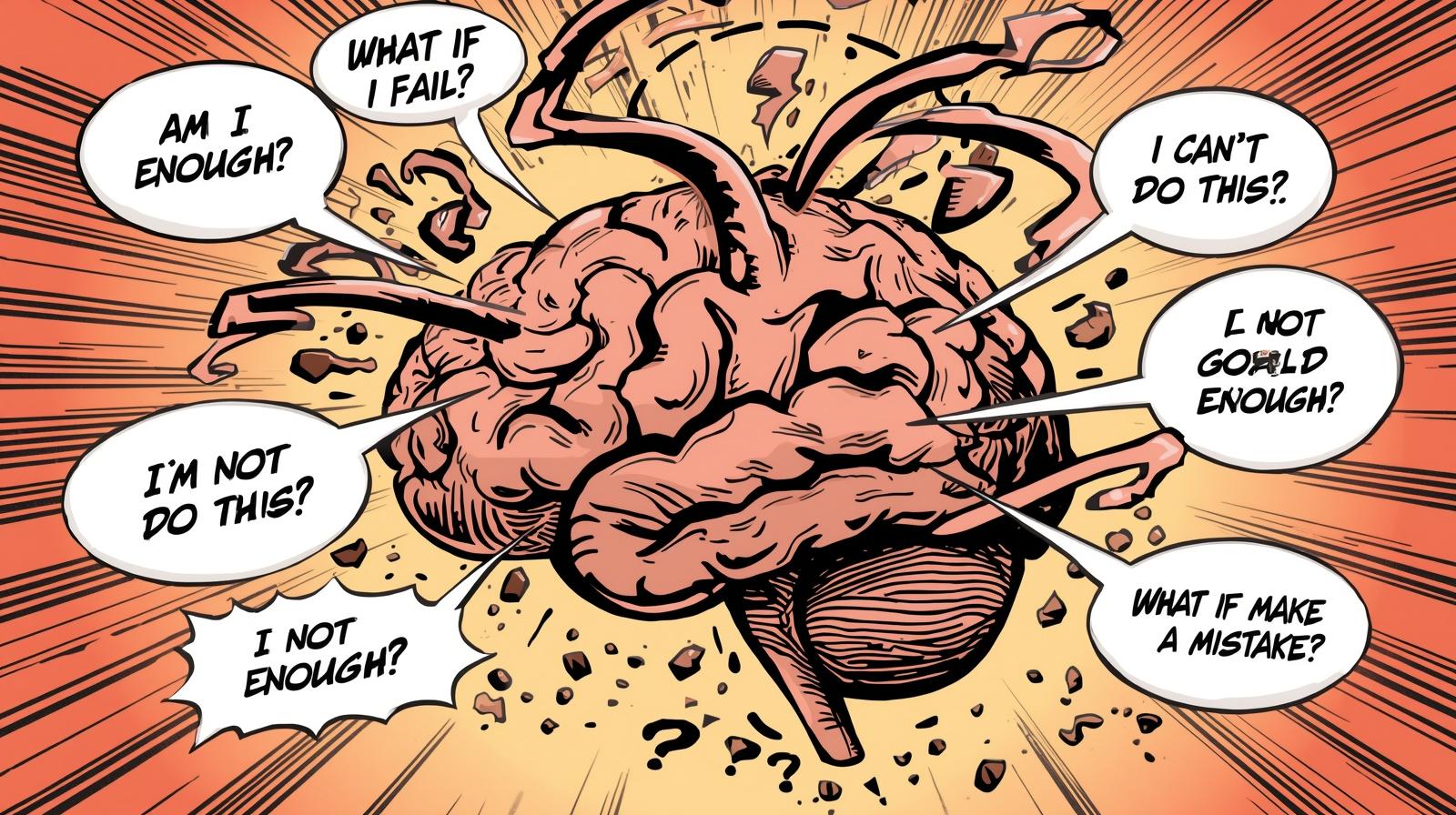
When self-doubt takes the mic, it does not whisper once and leave.
It loops.
It questions, re-questions, and then questions whether the questioning was thorough enough. Even small, low-stakes decisions – what to reply, what to wear, whether to send the email – can become oddly exhausting.
The mind gets loud. Repetitive. Circular.
On the surface, the thoughts sound sensible. Responsible, even. But underneath? There’s anxiety humming in the background.
You might recognise some of these:
- “What if I choose the wrong thing?”
- “Maybe I should think about this again.”
- “I don’t trust myself to get this right.”
- “What if they judge me for this choice?”
- “I’ll just research it one more time.”
- “I’m going to make a mistake. I can feel it.”
These aren’t just practical considerations.
They’re charged.
The Tone of the Inner Voice
Self-doubt doesn’t usually sound like harsh self-criticism. It’s not yelling at you.
It’s more subtle than that.
The tone is often:
- Concerned
- Overly careful
- Skeptical of certainty
- Suspicious of confidence
- Deeply invested in worst-case scenarios
It can sound like a risk analyst who never signs off on the plan.
There’s always one more angle to consider. One more possible flaw. One more scenario to mentally rehearse.
The deeper message underneath is usually:
“If you act too quickly, something bad will happen.”
So you don’t act quickly.
In fact, you may not act at all.
The Endless “What If?” Loop
A hallmark of over-analysis is the unstoppable production of hypothetical futures.
- “What if this doesn’t work out?”
- “What if they take it the wrong way?”
- “What if I regret this later?”
- “What if there’s something I haven’t considered?”
Each “what if” gives birth to another one.
Your brain tries to pre-live every possible outcome so that nothing catches you off guard. The intention is preparation. The result is overwhelm.
You might find yourself:
- Rehearsing conversations repeatedly
- Imagining both best-case and worst-case scenarios in vivid detail
- Revisiting the same decision hours (or days) later
- Changing your mind multiple times
And even after you decide?
“Did I rush that?”
“Should I have waited?”
“Maybe I missed something.”
Resolution is brief. Doubt returns like it left something behind.
Distrust of Your Own Instinct
Self-doubt also sounds like suspicion toward your own inner knowing.
You might think:
- “That feels right… but what if I’m wrong?”
- “Other people probably know better.”
- “I shouldn’t trust my first instinct.”
- “I need more opinions before I decide.”
Even when something feels aligned, the mind steps in with counterarguments. Confidence barely has time to sit down before it’s cross-examined.
There can even be a subtle belief that certainty is reckless.
“Only arrogant people are sure of themselves.”
So you stay in deliberation. It feels safer there.
Safer in theory, anyway.
Catastrophic Forecasting
One of the more convincing tricks self-doubt pulls is exaggerating consequences.
Small decisions get framed as pivotal, life-altering moments.
- “If I choose wrong, this could ruin everything.”
- “This mistake could set me back completely.”
- “People will see I’m not capable.”
The scale of the imagined outcome rarely matches the actual decision.
Choosing a new project becomes “What if this derails my career?”
Sending a message becomes “What if this permanently changes how they see me?”
Your nervous system reacts as if the stakes are enormous.
Meanwhile, objectively… you’re deciding whether to follow up on an email.
The Internal Maze
Over time, your mind can start to feel like a maze with no exit.
Every answer leads to another question.
Every solution uncovers another possible flaw.
You may notice:
- Mental fatigue without forward movement
- Difficulty feeling settled
- A sense of spinning internally
- A surprising amount of relief when someone else decides for you
Because when someone else makes the call, the maze briefly disappears.
The mind has been searching for certainty – but certainty keeps moving further away.
The Subtle Core Message
Beneath all of this noise is a central fear:
“I cannot afford to be wrong.”
Self-doubt speaks in hypotheticals, but its emotional driver is protection. It believes caution prevents harm. It believes more thinking equals more safety.
And to be fair, thinking can be useful.
But life doesn’t offer guarantees. So no matter how much you analyse, the final layer of certainty never quite arrives.
The result? A mental landscape full of loops instead of conclusions. A system that values certainty over movement. Analysis over trust.
Learning to Recognise the Sound
There’s something powerful about recognising the tone of this inner voice.
When you can hear it (repetitive, cautious, fear-based) you start to see that the problem isn’t your intelligence or your capability.
It’s a mind trying to solve uncertainty with more thinking.
And sometimes what it actually needs isn’t another round of analysis.
It’s permission to choose.
Imperfectly.
Without guarantees.
But freely.
Want to work with this pattern more closely? Take the ‘pay what you can’ YouTube workshop…
…or grab access to the mini-course here.
Join my growing community on Instagram @DrMaddieSmith
© 2026 Dr Madeleine Smith