
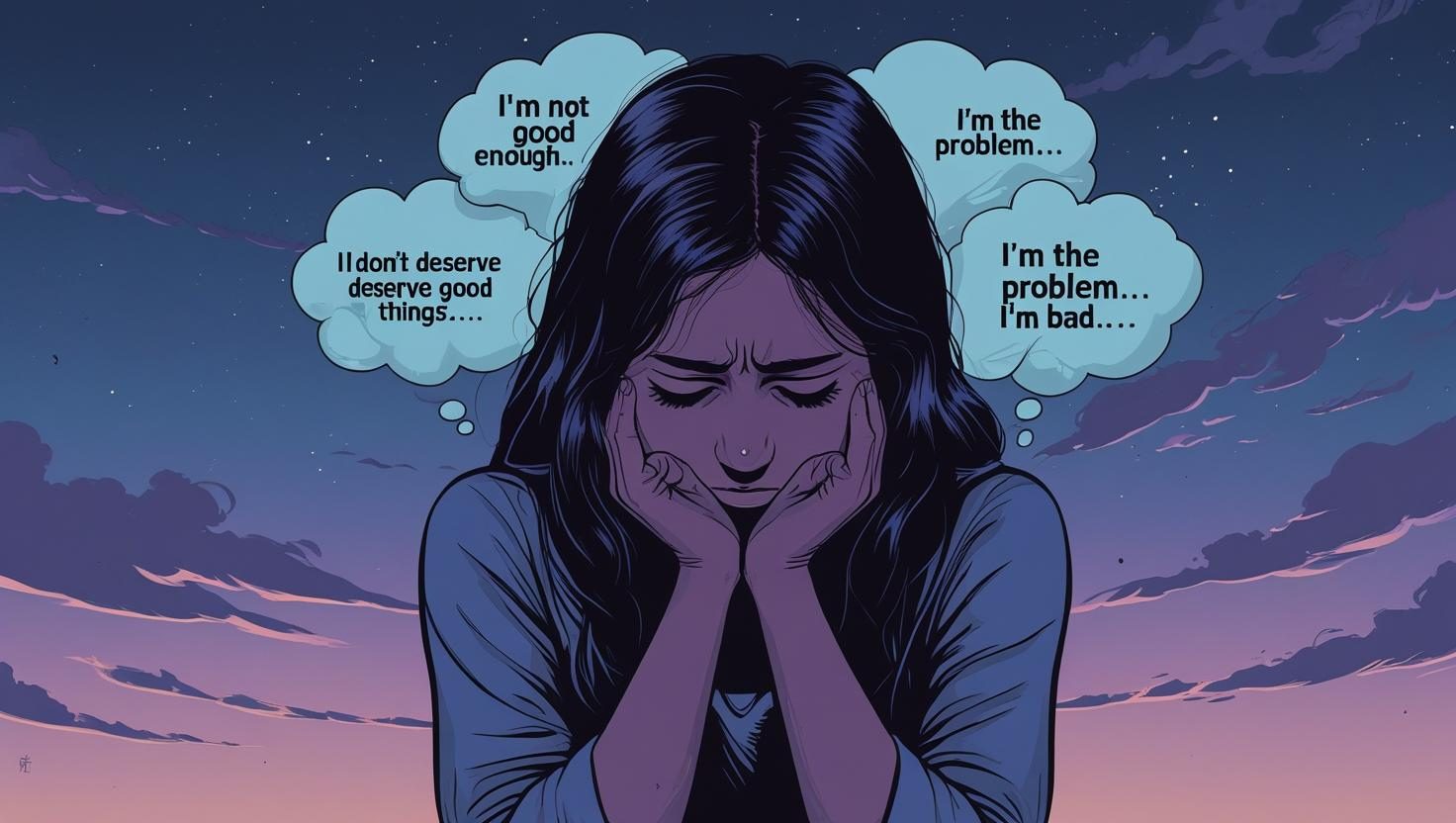
Most of us have an inner voice. Ideally, it’s something like a mildly encouraging coach: “Okay, that didn’t go great, but we’ll figure it out.”
Harsh self-criticism, on the other hand, is more like having a hostile commentator living in your head, narrating your life with the tone of a disappointed judge on a reality TV show.
It’s the internal stance where, instead of supporting yourself, you attack yourself.
This voice scrutinises everything you do, magnifies your flaws, and turns ordinary human mistakes into character defects. You forget to reply to a message? “I’m terrible at relationships.” You make an error at work? “I’m incompetent and everyone will eventually realise.”
The language is usually absolute and moralising:
- “I’m useless.”
- “I always mess things up.”
- “There’s something wrong with me.”
Over time, this stops feeling like a thought and starts feeling like the truth. Not an opinion. Not a habit. Just… facts about who you are.
Not the Same as Healthy Self-Reflection
Harsh self-criticism often masquerades as “being honest with yourself” or “having high standards.” But it’s not the same thing as healthy self-reflection.
Healthy self-reflection is:
- specific
- flexible
- focused on learning
It sounds like: “That presentation didn’t land. I need to prepare differently next time.”
Harsh self-criticism is:
- global
- rigid
- identity-based
It sounds like: “I am a failure.”
See the difference? One talks about behaviour. The other rewrites your entire identity. It collapses what happened into who you are. And instead of generating insight, it produces shame. Instead of motivating change, it tends to produce paralysis.
You don’t become better – you just become smaller.
When Your Mind Becomes a Courtroom
In more extreme forms, self-criticism becomes what psychologists sometimes call inner persecution.
This goes beyond self-judgment. It’s a relentless internal hostility where you are positioned as the problem. You’re not just living your life – you’re constantly on trial inside your own head.
Your mind becomes an internal court:
- monitoring your thoughts
- judging your emotions
- evaluating your performance
- questioning whether you’re even allowed to feel okay
There’s often a sense that you must justify yourself, prove yourself, or earn the right to exist comfortably. Rest feels suspicious. Pride feels undeserved. Ease feels like you’re getting away with something.
It’s exhausting. And no, you never win the case.
How This Pattern Usually Develops
Harsh self-criticism isn’t a personality flaw. It’s usually a learned survival strategy.
Many people develop it in environments where:
- approval was conditional
- mistakes were punished or shamed
- emotions were ignored or dismissed
- standards were impossible to meet
In those contexts, self-attack can actually feel protective:
“If I criticise myself first, maybe others won’t.”
“If I’m hard on myself, I won’t get rejected.”
Over time, external voices become internal ones. What started as a way to stay safe becomes a way of hurting yourself from the inside.
Your mind learned: threat works better than care.
What’s Happening in the Brain
Here’s the slightly ironic part.
Self-criticism activates the brain’s threat system – the same circuitry involved in fear, danger, and social rejection. When you attack yourself, your nervous system responds as if you’re under external threat.
So your body does things like:
- increase heart rate
- release stress hormones
- narrow attention
- shift into defence or shutdown
Which means chronic self-criticism isn’t just “negative thinking.” It’s a physiological stress state.
And the irony? The more you criticise yourself to “do better,” the more you impair:
- learning
- creativity
- emotional regulation
- motivation
In other words, the strategy designed to make you improve literally makes improvement harder.
Your nervous system is too busy bracing for impact.
The Emotional Cost
Living with inner persecution slowly erodes your sense of self-safety.
You may notice:
- difficulty resting without guilt
- achievements feeling hollow
- constant sense of “not enough”
- fear of being exposed or found out
- inability to enjoy things without self-monitoring
Even good moments can feel fragile, because the inner voice is already preparing its next critique. The bar keeps moving. Nothing ever quite counts.
There’s often a background feeling that something is fundamentally wrong with you – not in a specific, fixable way, but at the level of your existence.
Not “I made a mistake.”
More like “I am the mistake.”
Self-Criticism Is Not Responsibility
This part matters a lot.
Harsh self-criticism is not the same as:
- accountability
- responsibility
- humility
- ethical awareness
You can acknowledge harm, limits, and mistakes without attacking your identity. You can take responsibility without emotionally assaulting yourself.
Self-criticism confuses behaviour with worth.
It treats imperfection as evidence of being fundamentally defective, rather than as the normal condition of being human.
Which is… unfortunate, because being human is quite literally a situation where mistakes are guaranteed.
When the Mind Becomes a Hostile Place
In its most extreme form, inner persecution becomes a kind of internalised violence.
Your inner world stops being a place of guidance and becomes a place of surveillance.
Thoughts feel dangerous.
Emotions feel wrong.
The self feels unacceptable.
You’re no longer just experiencing life – you’re constantly managing, correcting, judging, and policing yourself.
It’s like living with a very intense internal manager who never takes a day off and has never heard of positive feedback.
The Key Reframe
Harsh self-criticism is not a sign of strong character or high standards.
It’s a sign of a nervous system that learned to relate to itself through threat rather than care.
And while it often feels like “the truth about who I am,” it’s better understood as a learned mental posture – a habit of relating to yourself that developed for a reason, but can be unlearned.
Not by pretending everything is fine.
Not by forced positivity.
But by gradually replacing inner hostility with something far more radical:
A relationship with yourself that is realistic, compassionate, and on your side.
Which, honestly, is a much better foundation for change than being yelled at by your own brain 24/7.
Want to work with this pattern more closely? Take the ‘pay what you can’ YouTube workshop…
…or grab access to the mini-course here.
Join my growing community on Instagram @DrMaddieSmith
© 2026 Dr Madeleine Smith