
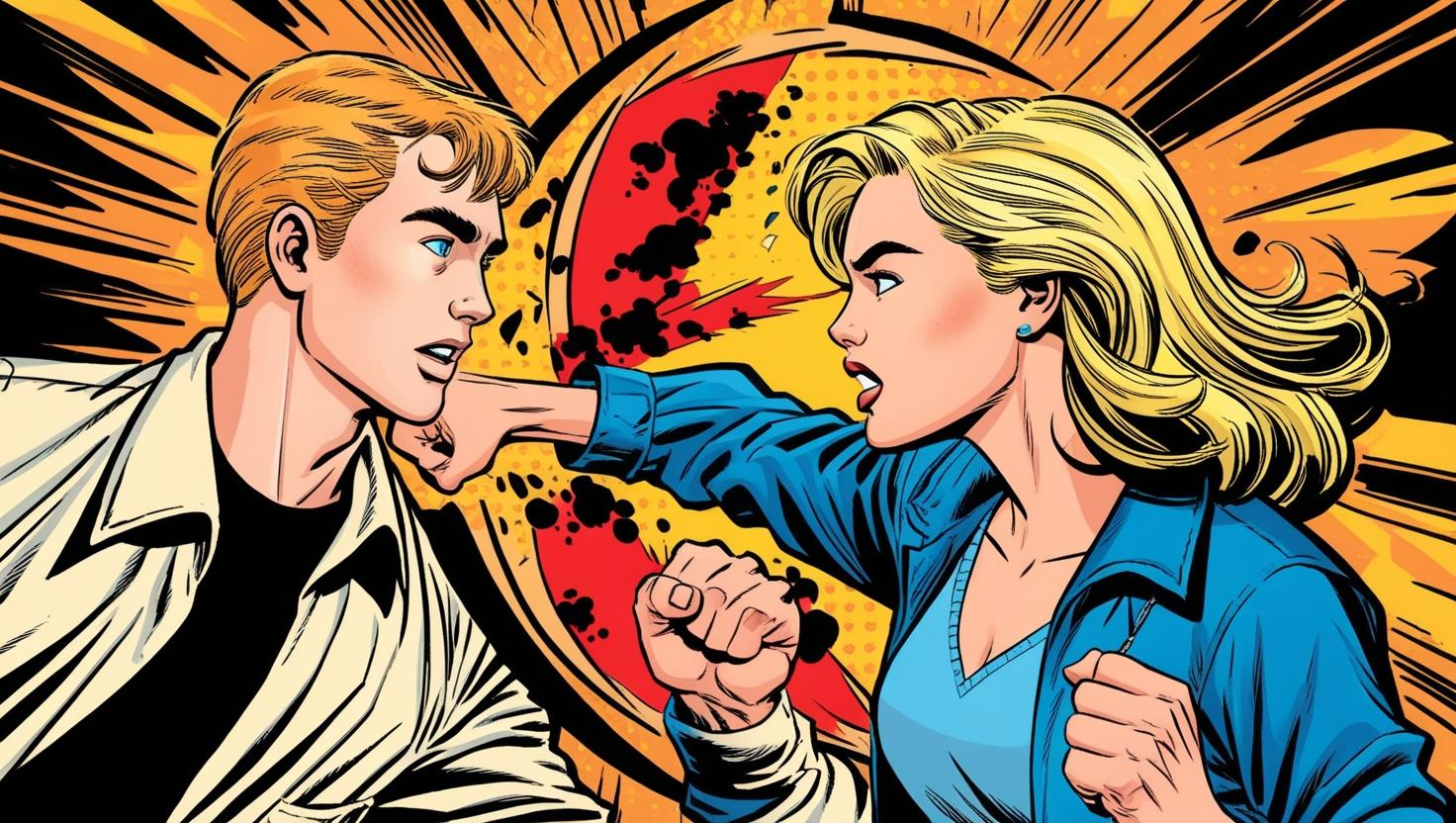
Buffy the Vampire Slayer meets Dexter: Original Sin.
Buffy Summers. High school student by day, vampire slayer by night. Dexter Morgan. A serial killer/vigilante who moonlights as a forensic detective. Apart from featuring iconic actress Sarah Michelle Gellar, you could be forgiven for wondering what the Buffyverse and the Dexterverse could possibly have in common. It’s about to get personal.
In every generation
Buffy the Vampire Slayer (1997-2003) defined my teenage years. As for most hormonal adolescents, they were full of emotional anguish and drama. I could relate. Then there was Dexter (2006-2013). From the moment Dexter (Michael C Hall) selected his victim in the first episode, infused with vigilante overtones, I was hooked. Also likely one of the few people on the planet at peace with the ending: Dexter in the wilderness, cast out of society because of his nocturnal activities. Later came Dexter: New Blood (2021) and Dexter was seemingly killed off.
But then it happened. Rumblings of movement, and then a cast list. The prequel we never knew we needed. At the time of writing this post, new series Dexter: Original Sin (2024) is premiering. The series will explore Dexter’s (Patrick Gibson) life as a young man and his relationship with adoptive father Harry (Christian Slater) as he learns his craft. Imagine my delight to find Sarah Michelle Gellar had been cast as Tanya Martin, forensic detective. The pieces began to make a pattern.
Come with me on a journey through TV’s most unexpected and compelling coupling into the murky depths of violent traditions, vigilantism, pain-passing and generational trauma. Let’s get stuck in.
The Mentor and the Watcher
Dexter and Buffy are both guided by mentors and father figures responsible for shaping and encouraging their paths. In Dexter, this person is Harry (James Remar) through flashbacks. In Buffy, it’s Giles (Anthony Stewart-Head).
The Mentor
Harry is the one who first identifies Dexter’s propensity for violence, having adopted him following the brutal murder of Dexter’s mother. Harry confronts Dexter after finding animal remains, telling the child that he is different and that “I’m afraid your urge to kill is only going to get stronger.” (‘Dexter’, 1.1) Harry is shown to forcibly instil vigilante ideals in Dexter, shaping his son’s attitudes, values, actions and destiny. He does this by reinforcing his son’s differences and by teaching Dexter a code that facilitates murder.
The Watcher
Giles performs a similar function as Buffy’s Watcher. After Buffy’s arrival at the Hellmouth, the bumbling librarian quickly establishes himself an instructive and paternal figure in the teens life. Giles regularly scolds Buffy’s attitude and makes disapproving comments about her conduct. He guides her physical training and demon studies, and installs routines around patrolling and slaying. Like Harry, Giles regularly emphasises Buffy’s differences and actively directs her innate Slayer kill-instincts towards monsters.
Both Giles and Harry try to protect their respective mentees with their actions, helping them fit in by insisting on secrecy and hiding their true selves under the guise of normalcy. For Harry, this means teaching Dexter how to blend in and fake social interactions. For Giles, Buffy must isolate to protect others, but as viewers well know, Buffy is not one to follow the rules.
Harry’s Code and the Slayer handbook
“There’s a Slayer handbook?” – What’s My Line, pt. 2 (Buffy, 2.9)
The Code
Harry’s Code is a set of rules that Dexter must live by so that he can kill whilst maintaining a ruse of normality. The rules are designed to stop him from committing senseless murder by channelling his urges towards specific targets. Some rules point to social preservation, such as ‘never kill an innocent’ and ‘killing must serve a purpose’. Others allude to self-preservation, like ‘don’t get caught’ and ‘fake emotions and normality.’
Whilst Dexter rarely deviates from Harry’s Code, he does upon occasion consciously choose to do so. For instance he kills to protect Astor (Christina Robinson) from a paedophile (‘The Lion Sleeps Tonight’, 3.3). He sometimes acts impulsively, breaking the Code in a burst of emotion, such as after Rita’s (Julie Benz) death (‘My Bad’, 5.1). The Code is also not fool-proof, as Dexter discovers when he accidentally murders an innocent person in ‘Slack Tide’ (4.7).
The Slayer handbook
For Buffy, the Slayer handbook contains history and rules about magic and the supernatural world. It also provides instructions for how to operate as the Slayer without exposing her identity. This includes aspects that again require activities deigned to protect society and her loved ones whilst maintaining her separateness from it. The handbook functions as a means of self-preservation (as much as can be possible for the short life of a Slayer).
Unlike Dexter, and although she does follow the general guidelines on operation and secrecy, Buffy is inclined to rebel. She quickly establishes a group of friends in the know (‘The Harvest’, 1.2) turning them into a source of strength. For instance, she merges with them to defeat an uber demon in ‘Primeval’, (4.21). She dates vampires Angel (David Boreanaz) and Spike (James Marsters). Buffy also quits the Watcher’s Council, who oversee Watcher and Slayer operations (‘Graduation Day’, 3.21).
Violent traditions
Serial killing
Violent traditions punctuate Dexter, as Harry teaches Dexter how to hunt as a way to channel his murderous urges (‘Popping Cherry’, 1.3). Harry shows him how to use a gun, and how to store and clean knives. This presents weapons culture as a male bonding activity. He encourages Dexter to kill animals with a warm and gentle smile. In Dexter, violent pastimes are a socially acceptable way to commit murder and are a central feature of father-son relationships.
In a perverse abuse of their bond, Harry teaches Dexter how to kill people and provides him with a means to do so via the Code. He directs him to unleash violence on others. Harry also teaches his son to turn that violence within by consistently reinforcing the message to Dexter that he is alone, broken and unfixable. Hello, Dark Passenger. Of this compulsion to kill, Dexter explains, “He’s all I’ve got; nothing else could love me. Or is that just a lie the Dark Passenger tells me?” (‘An Inconvenient Lie’, 2.3) Harry and the Dark Passenger are fused into one. It is a voice that remains, driving Dexter’s actions long after Harry is dead.
Serial slaying
In Buffy, violent traditions are underscored by the Watchers Council, who use Slayers to kill demons and protect the mortal realm. Hundreds of young women over centuries, sent to their violent deaths. There are also numerous training and hunting rituals between Buffy and Giles. The pair practice honing and developing Buffy’s fighting techniques and skill with weapons, and patrol cemeteries at night, looking for monsters to kill.
As in Dexter, killing monsters is positioned as acceptable and even necessary to protect humanity. But violent traditions are often fused with shame in Buffy, and there’s a line that cannot be crossed: Buffy is devastated when impulsive slayer Faith kills a human (‘Bad Girls’, 3.15), and is horrified by her own behaviour when she savagely beats Spike (‘Dead Things’, 6.13).
Violence in the family unit
“There are no secrets in life, just hidden truths that lie beneath the surface.” – Crocodile (Dexter, 1.2)
Violent families, pt.1
Violence in the family unit is an ever-present threat in both shows. In Dexter, Harry crafts a life of secrecy and murder. Hidden in plain sight under the guise of a ‘normal’ family life, he teaches Dexter how to fake social interactions and lie. We see this in numerous flashbacks in early seasons. Posing for photos, getting ready for prom, lying to his sister Debra (Jennifer Carpenter): Family masks a dark, violent reality.
Dexter continues this pattern with Rita, who is a perpetual victim of the white patriarchal nuclear family unit. She escaped an abusive relationship with the father of her children only to enter a faux-relationship with Dexter that he uses as a cover to hide his true nature. Indeed, Rita’s life has a tragic and violent end as she is brutally murdered by Trinity Killer Arthur Mitchell (John Lithgow).
Throughout season four, Trinity operates under a guise of normalcy with his picture-perfect family and charitable lifestyle, but these conceal a horrifying truth: Trinity re-enacts a cycle of barbaric murders, painstakingly recreating the deaths of his parents and sister. He terrorises his own family with his violent temper, hiding behind its idyllic façade. For Arthur, Harry and Dexter, the ideological function of the family provides a cover for extreme violence and suffering.
Violent families, pt.2
In Buffy, mother Joyce (Kristine Sutherland) raises her daughter as a one-parent family with minimal references to Buffy’s largely absent father. When patriarchal family life does appear, violence is endemic. Joyce’s boyfriend Ted (John Ritter) beats Buffy, drugs their cookies, and turns out to be a serial wife-killing robot (‘Ted’, 2.11). All of Buffy’s closest friends have dysfunctional home lives. And through vampires Angel, Darla (Julie Benz), Drusilla (Juliet Landau) and Spike, the family unit is exposed as perverse, violent, and inherently destructive.
Giles routinely violates his position as Buffy’s mentor and father figure through his participation in violent traditions. He sends her to her potential death every night on patrol. He deceives her in the aptly named ‘Lies My Parents Told Me’ (7.17), and enacts a ‘rite of passage’ on her 16th birthday in ‘Helpless’ (3.12). In this episode, he hypnotises and drugs Buffy, injecting her with a magical substance that weakens her and puts her in danger. Ultimately, Giles leaves when he realises that his presence is holding Buffy back.
Generational trauma
“Some experiences are so big they change your DNA.” – Everything is Illumenated (Dexter, 5.6)
Born in blood
Patterns of violence and murder, passed on through generations, are central features of both shows. Violent and traumatic experiences are shown to shape beliefs and behaviours, affecting subsequent family members. As a child Dexter witnessed the murder of his mother, a traumatic event that Harry believes is the primary cause of Dexter’s murderous impulses. This pattern repeats as Dexter’s own infant son Harrison is present when Rita is killed. Harrison (Jack Alcott) later finds Dexter in small town America in Dexter: New Blood. Now a young man, he reveals his own battle with murderous impulses: the cycle repeats.
Born of death
In Buffy, the notion of multi-generational trauma is overtly present through the line of the Slayers. One chosen in every generation to fight vampires and demons, and the forces of darkness. Buffy is intricately tied to the other Slayers and their experiences through dreams, visions and memories. She experiences this initially when she is ‘activated’ as a Slayer. This moment follows the death of the previous Slayer, making it an innately violent and multi-generational cycle.
Buffy discovers the origin of the Slayer line in ‘Get it Done’ (7.15). She meets the first Watchers and experiences how they created the first Slayer by restraining and violating the young woman with the spirit of a demon. This traumatic moment caused a violent pattern to begin, becoming embedded in the line of Slayers in their short, tragic lives: when one slayer dies, another is born. The Watchers Council thus perpetuates an endless cycle of extreme violence and death towards women.
Pain-passing
“I’m the thing that monsters have nightmares about.” – Showtime (Buffy, 7.11)
Payback…
All of this trauma, violence and pain inevitably spirals out to others. In Dexter, the tendency towards pain-passing is overtly implied through Dexter’s actions. He witnessed his mother being brutally murdered and he copes with this event by killing others who he believes are deserving of his knife. As we often see, the loved ones of his victims don’t always agree (‘Our Father’, 3.1), and Dexter’s pain ripples out into the world. For rape-torture survivor Lumen (Julia Stiles), her emotional suffering causes her to lash out at others as she tries to hunt down her abusers (‘First Blood’, 5.5).
We can also see the tendency to pass the pain along play out through Harry, with tragic consequences. After the death of his patrol partner in the episode ‘Crocodile’ (1.2), Harry is visibly stricken by anger and grief that the killer has escaped justice. He tells his impressionable son that “It’s not about vengeance; it’s not about retaliation, or balancing the books. It’s about something deep inside.” Dexter then murders the killer. The implications are clear: Dexter’s vigilante acts are being directed and influenced by Harry’s personal pain.
…is a bitch
For Buffy, the metaphor is simple. Fighting vampires and demons is a means through which to cope with life’s trials and traumas. After Buffy’s almost fatal encounter with the Master (Mark Metcalfe) at the end of season one, she struggles to cope with the experience. Buffy lashes out at her friends and makes everyone feel like crap by dirty dancing with Xander (Nicholas Brendan). She eventually directs her pain to its source by smashing the Master’s bones to dust with a sledge hammer (‘When She Was Bad’, 2.1).
Pain-passing shows up for other characters too. After her lover is murdered, Willow (Alyson Hannigan) goes on a killing rampage and almost destroys the world. Faith, brutalised and let down by everyone, turns evil, hurting and murdering anyone that gets close enough. And of course, there’s the vampires themselves: a violent death begets endless violent deaths, passing pain out into the world in an endless wave.
Vigilantism or serial killing?
For Dexter and Buffy, vigilantism is the primary means through which both characters channel their own pain and traumas. This creates a parallel between the two shows’ titular stars as monster killers: they fight the forces of darkness for the good of society, whilst using this act as a cathartic coping mechanism.
The serial vigilante
In Dexter, Harry’s Code instructs Dexter to only kill other killers who have escaped justice. It is a tool that enables Dexter to kill. Though it is a by-product, the Code is fused with vigilantism. Dexter is judge, jury and executioner. He gathers proof of guilt of his victims, before meting out swift and final retribution. Dexter tells his nemesis Doakes (Erik King), “I’ve got news for you, sergeant. My code requires a higher standard of proof than your city’s laws.” (‘There’s Something About Harry’, 2.10) But Dexter doesn’t use this proof in the name of justice. He withholds it from sanctioned forces of law and order so that he can kill. Vigilantism is Dexter’s serial crime.
The intrinsic relationship between vigilantism and serial killing is explored throughout season two when Dexter’s crimes are discovered. This plays out through the characters around him in ‘The Dark Defender’ (2.5). Standing in line for a coffee, he overhears customers debating about the social value of the crimes. Later, Dexter discovers a comic book has been created that positions him as a vigilante hero. His sister Debra expresses an opposing view in a wry moment, arguing, “He’s killing people, Dex. Dad taught us the value of human life.”
The debate surrounding the nature of vigilantism as a societal ill or aid plays out through the show’s entirety. Ultimately, horrified by his creation, Harry takes his own life after he walks in on Dexter dismembering the body of his partner’s killer in ‘There’s Something About Harry’ (2.10). Dexter does not necessarily condemn or condone Harry’s actions or views concerning the Code, but does explore them, burdening the viewer with the same moral dilemmas.
The supernatural vigilante
The supernatural world is not subject to human laws and systems in Buffy, and neither are its Slayers and demons. A traditional understanding of vigilantism can be applied here, as arising in response to ineffectual or absent law enforcement. Buffy explains to her new friends that where monsters are concerned, the police “couldn’t handle it even if they did show up. They’d only come with guns.” (‘The Harvest’, 1.2) This positions Buffy, with her unique fighting skills and know-how, as the only solution.
The tension between the supernatural world and human laws plays out across Buffy primarily through the character of Faith. Wild and murderous with unnatural strength and violent inclinations, the police are unable to restrain Faith and cannot hold her to account for her crimes. Here, justice can only be upheld through personal choice and accountability: Faith’s. She eventually turns herself in to the police in Angel (1999-2004) in ‘Sanctuary’ (1.19), ready to atone for her crimes.
Where do we go from here?
Let me begin the end with Buffy. Buffy is a cycle breaker. She challenges the primacy of patriarchy when she quits the council. She ends the pattern of violence and death against females by imbuing every girl who might be a Slayer with power. Buffy quite literally defeats death (several times!). AND she builds her own inclusive, matriarchal family unit, led by women for the benefit of all. Girl, Slay.
Now let me end with a new beginning. So far, Dexter has perpetuated all of the horrific things that have been done to him, and you know what? I wouldn’t change a thing. When these themes arise it shows us what is there, just waiting to be explored and understood within ourselves and our social systems. It also provides a cathartic release for our own pain.
I’m so excited to see if and how these themes continue to play out in Dexter: Original Sin and I can’t WAIT to see if any of them change in Dexter: Resurrection (2025). Yes. HE’S BACK.
Want to know more about vigilantism in Dexter? Check out my book here.
© Dr Madeleine Smith (2024)